

We all have parts of our body we love and parts we prefer not to put in the spotlight. That is perfectly human and normal. But knowing how to flatter your silhouette does not mean hiding or correcting — it means choosing with awareness, understanding which cuts and fabrics work in your favour, and building a look that makes you feel truly good.
In this guide you will find the basic principles of visual optics applied to clothing, practical advice for different body types and concrete suggestions from the Opificio Modenese SS26 collection — a brand that has been studying fit across different bodies for over thirty years.
The lines that make the difference: how visual optics work in clothing
Before talking about specific body types, it is useful to understand a few basic principles. These are tools, not rules. Knowing them helps you make more informed choices.
Vertical lines elongate the figure. A dress with vertical draping, a longuette skirt, a shirt with a central button placket — all elements that guide the eye from top to bottom, creating a lengthening effect.
Horizontal lines add volume. A structured shoulder, a belt that interrupts the figure, a detailed hem — these stop the eye and add visual presence at that point.
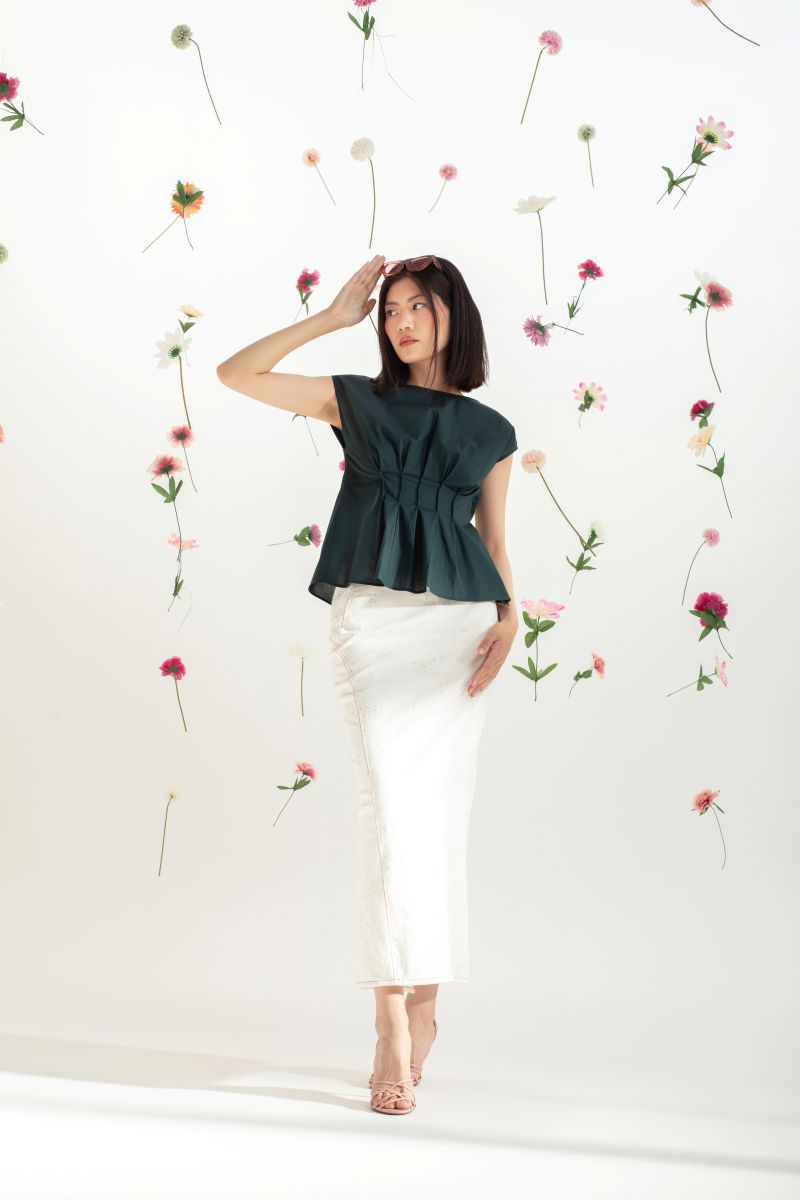
A defined waistline creates proportions. Even when the waist is not naturally marked, a belt, a knot or a waist elastic can create it visually, balancing the figure above and below.
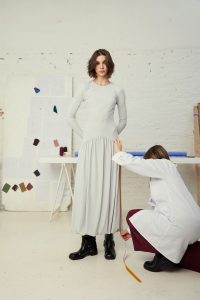
Draping softens. Fabrics that fall softly on the body — without clinging rigidly — tend to be universally flattering: they follow the shapes without marking, creating movement and lightness.
Advice by body type
These are not rigid categories to fit into. They are common situations that many women identify with, fully or partially. Take them as suggestions, not labels.
An undefined waist: how to create it visually
When the waistline is not naturally marked, the goal is to create it with the garment. Belts are the most direct ally. Pieces with a waist elastic or a thin tie at the waist — that marks the point without constricting — also work very well. What to avoid: pieces that fall straight from shoulder to hem, which tend to flatten the figure.
The chemisier dress with belt is designed exactly for this: the tie belt at the waist creates a defined, customisable proportion. The suede-effect waistcoat with belt is instead an excellent solution for those who prefer to work on the waist with a separate piece, to pair with trousers or a skirt.
Hips and shoulders to balance: how to work on proportions
When hips are more pronounced than shoulders — or vice versa — the goal is to create a visual balance. For those with wider hips, pieces that add volume at the top work well: structured shoulders, blouses with shoulder details, horizontal necklines. For those with broader shoulders, it is better to concentrate detail at the bottom: full skirts, prints on the lower half, wide-leg trousers.
The green wide-leg trousers and denim wide-leg trousers are particularly suited to those who want to add volume to the lower half and balance a silhouette with more pronounced shoulders. Paired with the black asymmetric blouse — which lightens the shoulder thanks to the diagonal cut — the result is a balanced and contemporary look.
A fuller bust: necklines and cuts that flatter without overwhelming
The general rule is to avoid pieces with too much volume in the upper bust area, which tend to visually weigh down the figure. V-necklines work very well instead — they lengthen the neck and create a vertical line. Pieces with soft draping, without structured details on the chest, are an excellent alternative.
The draped midi dress with crater neckline is an ideal choice: the lateral draping creates movement without adding volume, and the Sensitive® fabric follows the body without marking. The pleated blouse in white also works well: the pleats start from the shoulder and fall vertically, elongating the figure in the upper half.
A petite frame: how to add presence without being overwhelmed
Those with a smaller frame often face the opposite problem: overly wide pieces risk swamping the figure. The key is to choose balanced proportions. Smaller prints, as explained in our article on how to wear printed pieces, are more suitable than large ones. Crop pieces — paired with high-waisted skirts or trousers — create visually balanced proportions.
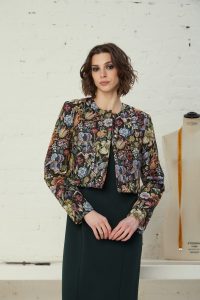
The cropped shirt with embroidered print paired with the beige longuette skirt is a perfect example: the crop adds proportion in the upper half, while the longuette elongates the figure in the lower half.
A tall, slender frame: how to play with volumes
Those who are tall have the advantage of being able to wear volumes and proportions that would be more challenging on other body types. Longuette skirts, maxi patterns, large prints, structured fabrics — everything works. It is also the right moment to play with layering and unusual proportions.
The asymmetric wrap midi skirt with velvet straps is a piece that particularly flatters a slender figure: the asymmetric hem creates movement and the volume of the skirt draws the eye downwards, balancing the silhouette. The green jacquard midi dress, with its structured pattern, is instead the ideal choice for those who want an impactful piece that makes the most of a tall, slender silhouette.
Start from what you love: the approach that changes everything
Up to now we have talked about working on proportions and balance. But there is a different approach, and perhaps a more liberating one: instead of asking “what do I need to hide?”, ask “what do I want to enhance?”.
An elegant shoulder. A neckline. The ankle. The décolleté. The arms. Whatever the part of your body you love most, that is the starting point for building the look. Everything else falls into place.
This shift in perspective is small in form but significant in substance. You stop dressing defensively and start dressing expressively. And it is exactly from this idea — enhance, not correct — that the Opificio Modenese philosophy is born: every piece is designed to exalt femininity, not to standardise it.
The role of fabric and fit: why a well-made piece changes everything
There is one final element that is often underestimated: the quality of the garment’s construction. A poorly cut dress or one in the wrong fabric does not flatter any body type, regardless of size. On the contrary, a well-constructed piece — with the right pattern-making, the right fabric and studied proportions — makes a difference on any body.
The Sensitive® fabric used in many Opificio Modenese pieces is a concrete example: stretch and breathable, it adapts to the body following its shapes without constricting or marking. It is not rigid, does not create tension, does not deform. It is this kind of attention — to the fabric, the cut, the fit across different body types — that makes a piece truly flattering, regardless of the size worn.
To find out more about how this care in garment construction comes about, read our article on how a Made in Italy garment is born.
Conclusion: flattering your silhouette is a matter of choice, not size
Knowing how to flatter your silhouette does not mean following rigid rules or hiding parts of yourself. It means knowing a few basic principles, starting from what you love, and choosing pieces built to enhance — not to standardise.
Discover all the pieces from the Opificio Modenese SS26 collection and find the ones that speak to your body and your style.
![Pantaloni fluidi OPI[MO]](https://www.opificiomodenese.com/wp-content/uploads/2018/06/opi-370x240_c.png "Pantaloni fluidi")