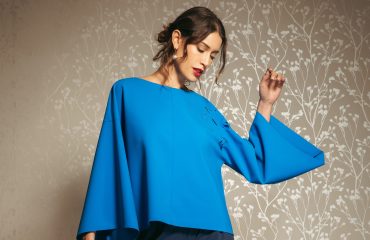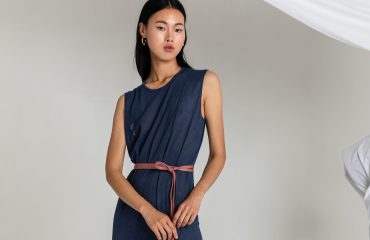

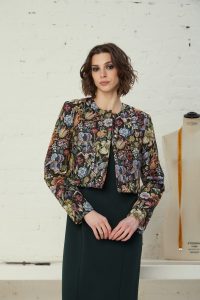

If you have already worn an Opificio Modenese piece, you have probably wondered where that softness comes from — that lightness that never needs ironing and holds up through washing over time. The answer is almost always the same: Sensitive® Fabrics.
In this guide we explain what this fabric is, who produces it, how it is made, and why sustainability is not just a promise for Eurojersey — and for us — but a measurable result.
What Sensitive® Fabrics is
Sensitive® Fabrics is a patented run-resistant technical fabric produced by Eurojersey S.p.A., an Italian company founded in 1959 and based in Caronno Pertusella, in the province of Varese. The Sensitive® patent was born in 1990 and launched commercially from 1993, first in swimwear, then in lingerie and finally in ready-to-wear.
The term “run-resistant” is not a minor detail: it means that the fabric, even when cut, does not unravel or fall apart. This is what makes raw-edge cuts possible — unfinished hems that maintain their shape over time — a feature found in many pieces of our collection.
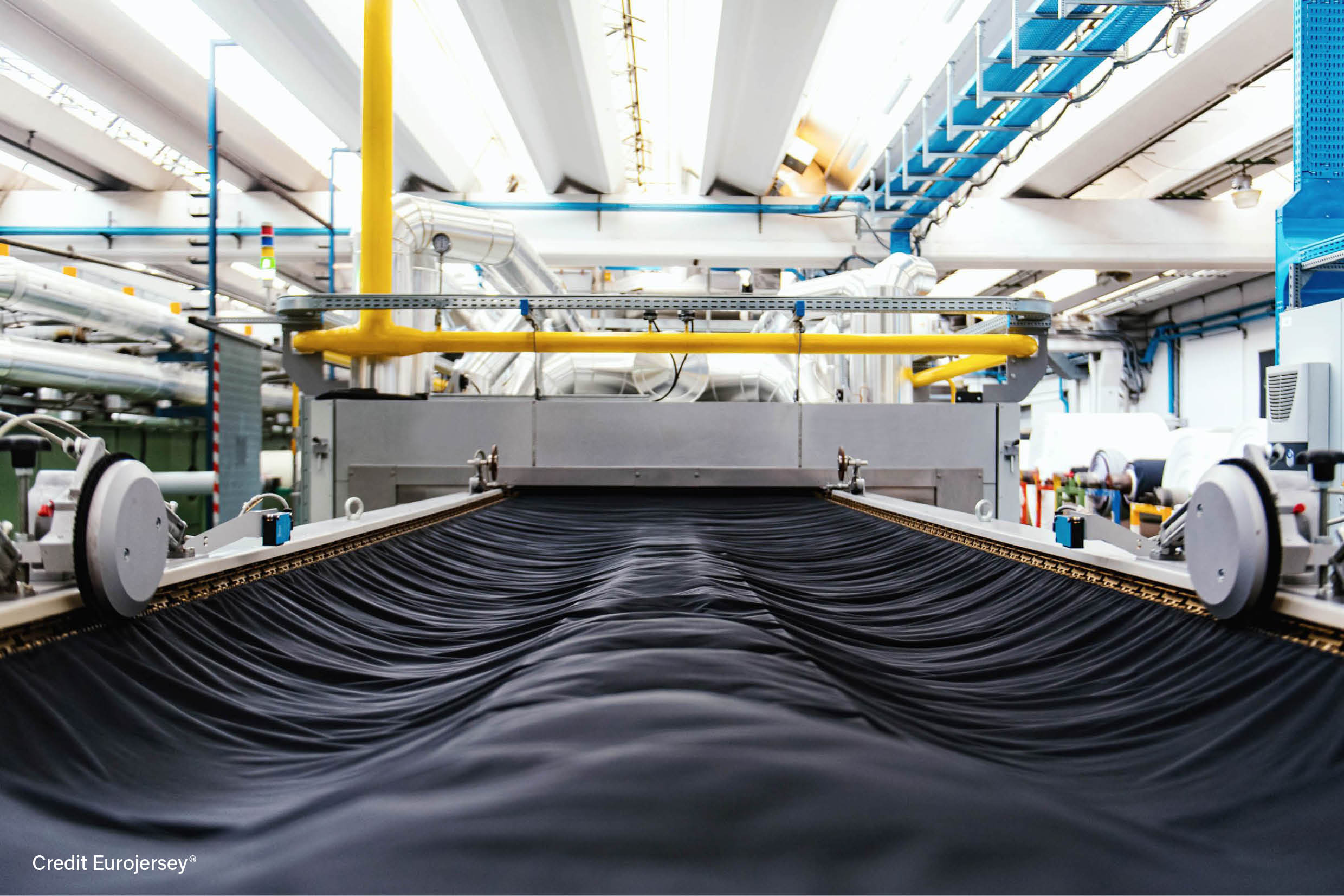
Eurojersey works with a fully integrated production plant, from knitting to dyeing, finishing and printing. Every phase takes place within the same facility, under direct and continuous control. We had the privilege of visiting it in person: you can read about the experience in our article on the visit to Eurojersey S.p.A.
A sustainable fabric: the SensitivEcoSystem® programme
The sustainability of Sensitive® is not a statement of principle. It is a structured, measurable and certified programme, launched by Eurojersey in 2008 under the name SensitivEcoSystem®.
The goal is to reduce the environmental impact of the entire production cycle: water consumption, energy, natural gas, chemicals and waste generation. These are not generic objectives: Eurojersey publishes its results every year, measured against real data.
Between 2015 and 2024, through continuous investment in production efficiency, Eurojersey significantly reduced consumption per kilogram of fabric produced — in terms of electricity, methane and water. These are concrete, documented and verifiable improvements, available on the Eurojersey website.
Practices adopted include: energy efficiency with photovoltaic panels, heat recovery from the fume purification system, water recovery and reuse, and reduction of chemical waste. All actions that translate into a production process with a progressively lower environmental footprint.
Certifications: sustainability verified by third parties
Eurojersey’s sustainability is not self-declared. It is certified by independent bodies.
Eurojersey is the first Italian textile company to obtain the Made Green in Italy certification, the voluntary national scheme proposed by the Italian Ministry of the Environment for the assessment and communication of the environmental footprint of products. To obtain it, Eurojersey applied the PEF (Product Environmental Footprint) methodology to the entire life cycle of Sensitive® Fabrics, measuring the impact across 16 environmental indicators — including water footprint, carbon footprint and energy footprint.
Eurojersey also holds the UNI EN ISO 14001 certification, renewed every year, which confirms compliance with the environmental management requirements defined by international standards.
For more details on certifications, visit the Eurojersey eco-certifications page.
Why a sustainable fabric lasts longer
There is a direct connection between sustainability and durability. A fabric produced to high quality standards — carefully selected raw materials, controlled processes, precise dyeing — is also a fabric that maintains its characteristics over time. It does not fade, does not deform, does not deteriorate after a few washes.
This is exactly the opposite of fast fashion logic: a garment that lasts is one that does not get thrown away, that does not need replacing every season, that does not end up in landfill after a few months. Choosing Sensitive® therefore means making a choice with a lower environmental impact not only in production, but across the entire life cycle of the garment.
The technical characteristics in practice
All the production process we have described translates into concrete characteristics, felt every time you wear a Sensitive® piece.
Stretch and adaptability: it follows the body through every movement without losing shape. It does not constrict, does not create tension, does not deform after washing.
Breathability: the knit structure allows air circulation, keeping the body dry and temperature regulated. It works well both in summer and during transitional seasons.
Crease-resistant and no-iron: it does not wrinkle. A Sensitive® piece that has been folded in a suitcase for hours returns to perfect condition simply by hanging it up. No iron needed — which also means lower domestic energy consumption.
Easy washing: machine washable at 30°, delicate cycle. Air dries in approximately two hours.
Raw-edge cuts: thanks to the run-resistant nature of the fabric, hems can be left unfinished. Some pieces in our collection have a raw edge that can be shortened at home with scissors — a design choice that eliminates finishing work and reduces waste.
How to wash and care for a Sensitive® garment
Machine wash at 30°, delicate cycle, liquid detergent without bleach, low spin. Air dry on a wide hanger, away from direct sunlight. No ironing needed — but if desired, use a low temperature setting on the reverse side of the garment with a protective cloth. Store in a cool, dry place.
Why we choose it
For Opificio Modenese, choosing Sensitive® Fabrics is not just a technical decision. It is a choice consistent with the way we design our pieces: with care for the materials, respect for the person who wears them, and awareness of the impact that every production decision has on the environment.
A fabric that lasts, that washes easily, that needs no ironing and that is produced with a documented and continuously improving environmental impact — this is exactly what we look for when selecting materials for our collection.
Discover the Sensitive® pieces available in the Opificio Modenese shop. To find out more about how these fabrics are used in garment design, read our article on how a Made in Italy garment is born. And if you are thinking about travelling with them, discover our guide on how to pack for summer holidays.