



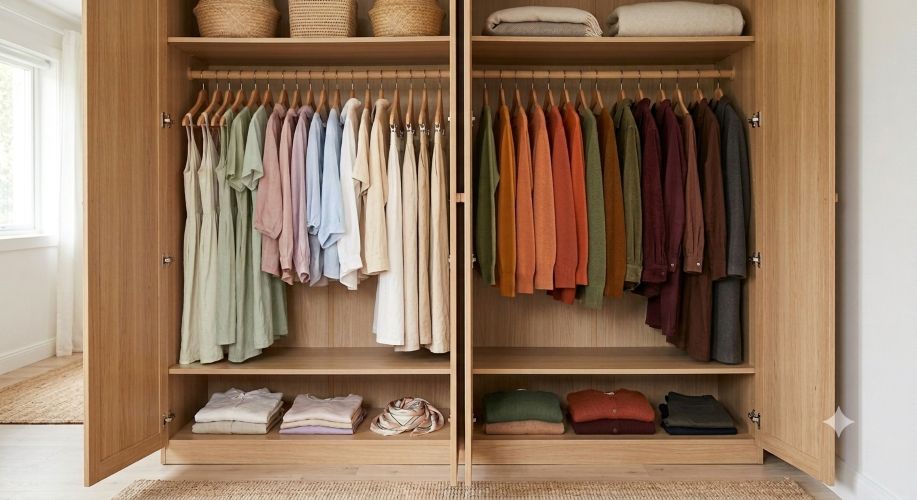
The seasonal closet switch is one of those tasks that constantly gets put off. Then September arrives, the temperatures drop, and you find yourself staring at a closet that no longer works. Summer clothes are still front and center, winter pieces are buried in the back, and you can’t find a thing. Doing a seasonal closet switch properly requires a method, not just time. In this guide, you will find all the steps to do it right — once and for all, without having to redo it.
When to Do the Seasonal Switch
There is no fixed date. In Italy, the right time is generally between late August and mid-September, when evening temperatures start to drop and you begin feeling like wearing something different. Don’t wait until it gets truly cold: anticipating the seasonal shift allows you to take your time, without the rush of searching for a sweater at the last minute.
Step One: Empty Everything
Before reorganizing, you need to see what you actually have. The most effective method for a seasonal closet switch is to completely empty the area you want to reorganize and lay everything out on a bed or a large surface. It might seem like an unnecessary step, but seeing all your clothes together gives you a clear overview of what you truly own — and you will often realize you have many duplicates, forgotten items, or pieces you haven’t worn in years.
How to Decide What to Keep: Asking the Right Questions
Before deciding what to do with each item, it is helpful to ask yourself a few practical questions.
-
Have I worn it in the last season? If the answer is no for two consecutive seasons, you probably won’t wear it in the next one either. Very specific items — like formal wear — are an exception, but this rule applies to 90% of your wardrobe.
-
Does it still fit well? Sizes, body shapes, and tastes change over time. Keeping clothes you don’t wear because you don’t feel good in them is useless — they take up space and generate frustration every time you open your closet.
-
Is it in good condition? Pilling, stains, snags, broken zippers — if an item is worn out to the point where it can no longer be worn with pleasure, it’s time to let it go.
-
Does it make me feel good when I wear it? This is perhaps the most important question. A piece you never wear because it “never fully convinces you” won’t improve as time passes.
The Four Categories: How to Sort Your Clothes
Once you have evaluated all your clothes, divide them into four groups:
-
Keep — Items in good condition that you wear regularly and that fit your current wardrobe.
-
Store away — Out-of-season clothes in good condition to be stored properly until the next switch.
-
Donate or sell — Clothes in good condition that you no longer wear. It is better to give them a second life rather than letting them take up useless space in your closet. Many organizations collect used clothing; secondhand platforms are a great alternative if you want to recoup some money.
-
Discard — Worn-out, stained, or irreparably damaged items. For non-recyclable textiles, many municipalities have dedicated collection points.
How to Store Out-of-Season Clothing
Items you put away deserve care. Storing them poorly means finding them the following year with unpleasant odors, misshapen, or damaged.
-
Wash everything before storing — even items that seem clean. Invisible odors and residues can attract moths and degrade fibers over time. For wool and delicate garments, use a specific detergent and lay them flat to dry before folding.
-
Use appropriate containers: breathable cardboard boxes, non-woven fabric bags, or vacuum-sealed bags for duvets. Avoid sealed plastic bags for natural fiber garments: since they don’t breathe, they can trap moisture and promote mold.
-
Add cedar balls or natural lavender sachets: they keep moths away without the chemical residue of traditional mothballs.
-
Store items in a cool, dry place away from direct sunlight. Avoid damp basements or attics with extreme temperatures.
How to Optimize Closet Space
The seasonal switch is also the perfect time to rethink your space layout.
-
Use matching hangers — preferably wood or non-slip velvet — for hung items. Plastic hangers distort garment shoulders over time and make the closet look cluttered.
-
Fold heavy items instead of hanging them: sweaters and hoodies lose their shape if left hanging for long periods. The vertical folding method — folding clothes so they stand upright in drawers — lets you see everything at a glance without having to shift items around.
-
Group clothes by category and then by color: first all pants, then all skirts, then blouses. Within each category, arrange from light to dark colors. It may seem like a purely aesthetic detail, but it actually reduces the time you spend searching for something each morning.
What to Add to Your Autumn Wardrobe
After clearing out and storing your summer clothes, it’s time to assess what is missing. Before shopping, however, identify the actual gaps — not just impulses — in your wardrobe.
Make a list of the items you found yourself looking for during the summer without finding, or those you wore so often they wore out. Those are the ones worth adding. Shopping intentionally, choosing quality pieces that pair well with what you already own, is always more effective than buying a lot without a strategy.
A functional wardrobe isn’t the one with the most clothes, but the one where every item has its place and a reason to be there.
The Seasonal Switch as an Opportunity for Mindfulness
Doing a seasonal closet switch isn’t just a practical task. It is also a moment to better understand your style, habits, and relationship with clothing. How many items do you buy and never wear? How many pieces do you keep “for when I lose weight” or “for a special occasion” that never comes?
A smaller, carefully curated wardrobe is almost always more functional and satisfying than a large, chaotic one. The quality of individual pieces — in fabrics, fit, and durability — makes the difference between an item you enjoy wearing every season and one that accumulates without ever truly being chosen.
To learn more about how to build a versatile wardrobe with high-quality pieces, read our guide on how to refresh your wardrobe with Opificio Modenese garments, and discover the Opificio Modenese collection to find the right pieces to start the new season with.

![Pantaloni fluidi OPI[MO]](https://www.opificiomodenese.com/wp-content/uploads/2018/06/opi-370x240_c.png "Pantaloni fluidi")